I stopped using Word and PowerPoint.
Not as an experiment. Not as a statement. It happened gradually, then completely. One day I noticed I hadn’t opened either application in months. The tools that once anchored my working life had become irrelevant. Not broken. Not replaced by newer versions of the same thing. Just unnecessary.
What replaced them was not another application. I describe what I need, and AI programs it: a document, a slide deck, a report, coded from intent rather than assembled in a template. The relationship with the work changed entirely.
The Packaging Trap
For decades, producing professional-looking output required one of three things. You mastered the tool: its formatting options, style systems, alignment grids, animation engines. You hired someone who had. Or you accepted results that looked mediocre and hoped the content would compensate.
It rarely did. A brilliant insight in a poorly formatted deck risks getting discounted before anyone engages with the ideas. Perception and packaging are entangled. We know this intuitively, which is why we spend so much time on it.
This constrained the work in two ways. First, the tool shaped the expression. You had a case that needed an interactive data exploration, but PowerPoint does static slides, so you flattened it. A nuanced relationship between three variables became a bar chart. The medium compressed the message.
Second, the packaging consumed the hours that should have gone to depth. Not for lack of ambition, but the time spent formatting left too little room for second and third order thinking. The connections between ideas that only surface when you sit with them long enough never got the space they needed.
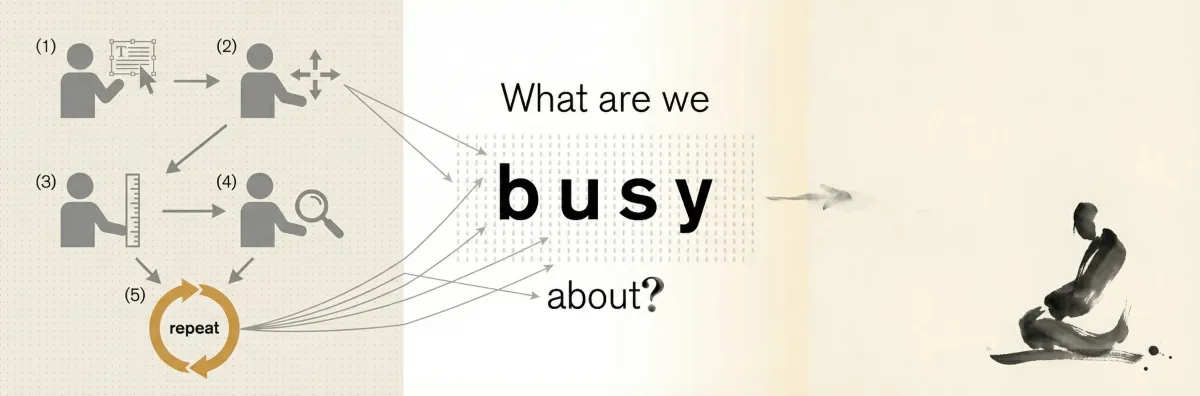
Thoreau wrote: “It is not enough to be busy. So are the ants. The question is: What are we busy about?” The trap is seductive because it feels like progress. Moving a text box ten pixels to the right. Adjusting the chart legend. Selecting the perfect template. You are “working.” Hours pass. The document looks better. But the argument it contains got a fraction of the attention it deserved.
What Changed
Last week I needed a marketing budget analysis for a client. Most of my time went where it mattered: working through different iterations, extracting the data points that could inform future decisions, building the case for where resources should go. When the thinking was done, I asked AI to program an HTML slide deck. It pulled the data from the files I had worked with, matched the brand colors, and produced something visually compelling: modern, subtle, responsive across screen sizes, exportable to any format. The entire file weighed about 100 kilobytes. Roughly 10% of my time went to the packaging. Ninety percent went to the thinking. In the past, that ratio sat closer to 40/60.
That ratio is not a productivity gain. It is a different way of working.
Before, I would oscillate between two modes: thinking about the content and thinking about the container. The container often won eventually. There is something gravitational about formatting work. It pulls you in because it offers constant, tangible feedback. You can see the improvement. The content work is harder to measure. You sit with an idea and you’re not sure if you’ve made progress or wasted an hour. The formatting gives you something to show for your time.
Now, I stay in the content. I spend my hours on curation, on connecting ideas across domains, on challenging my own assumptions, on testing whether a claim resonates or merely sounds convincing. When the document needs to exist, I describe it and it appears. Though as I’ve explored before, describing what you actually need is harder than it sounds. It forces you to make explicit what has always been tacit.
Which Effort Matters
I’ve written before about the danger of cognitive shortcuts. About desirable difficulty and how struggle builds capability. About the allure of letting AI do the hard work while our mental muscles atrophy.
The question was never whether AI saves effort. It was which effort it saves.
Formatting a report is not desirable difficulty. It does not deepen understanding, build wisdom, or sharpen judgment. It is a production skill that masquerades as knowledge work. Letting AI handle it is not a shortcut. It is a correction.
The thinking, the curation, the relational leaps between ideas, the willingness to sit with ambiguity before reaching for a framework: that effort remains essential. AI cannot do it for you. And if you let it try, you lose the very thing that made the output worth packaging in the first place.
The real discipline is knowing which struggle builds you and which just builds artifacts.
The Container Business
This shift is not just personal. It has structural consequences.
Microsoft is investing billions embedding Copilot into Word, Excel, and PowerPoint. The bet is clear: these tools remain the containers where knowledge work happens, and AI will make them better containers.
But my experience suggests something this thesis doesn’t account for. AI doesn’t make Word better. It makes Word unnecessary. The container itself is what’s being disrupted, not improved. It is the innovator’s dilemma playing out in real time.
There was always a saying in the industry: people use only 10% of what these tools can do. For decades, this was framed as a user problem. It was about learning the features. Taking the training course. The decisions about what to build were made far from the people who lived with the mismatch. Flip it. If 90% of the functionality is irrelevant to any given user, the tool is fundamentally generic. Built to serve everyone, it is optimized for no one.
Ivan Illich drew a distinction between “industrial tools” and “convivial tools.” Industrial tools impose their logic on the user: you learn the interface, adapt your workflow, think within the tool’s constraints. Convivial tools serve the user’s intent: the tool adapts to you. Word and PowerPoint are industrial tools. What AI enables is something closer to Illich’s convivial ideal: custom outputs that match exactly how you think and work. You describe what you need and AI programs it. The output becomes bespoke. Not a template filled in, but something generated from your thinking.
This challenges the software-as-a-service model at its foundation. SaaS sells access to generic capability at scale. When AI can assemble custom capability on demand, the 90% of unused features stops being a learning opportunity. It becomes dead weight.
Every corporate team has that one person with “the best slides.” The one whose decks get copied, whose templates circulate. Usually, their work combined strong thinking with strong packaging. They were admired for both. But the packaging is what made them visible. When AI handles the packaging, the question changes. It is no longer who presents best. It is who thinks best.
And this, in its own way, circles back to the bottleneck. The constraint was never the software. It was always our capacity to think clearly about what we actually need.
What Remains
The artifacts haven’t disappeared. I still produce documents, reports, presentations. But they are quickly becoming byproducts.
The deeper shift is that I stopped worrying about packaging at all. I define a visual standard with AI once, iterate on it gradually, and from then on I have full flexibility. LinkedIn post, client meeting, internal review: I don’t think about how to prepare something for a specific channel. I know the machine can handle any format, any time. That certainty is what frees the attention. Not a single reclaimed afternoon, but a permanent reallocation of where my mind goes while working.
Once you stop spending hours on packaging, you discover how much thinking you had been deferring.